Spam Checker Pro for Contact Form 7#
Multi-layered spam & security protection for Contact Form 7 — silent, zero-UI for your visitors, ruthless to bots.
Combines behavioural analysis (timing + honeypot), content inspection (SQLi/XSS/link/keyword signatures), network reputation (AbuseIPDB) and AI classification (LLM gateway, 11 providers) into a single, ordered pipeline. Everything is stored in purpose-built database tables, fully translatable (EN / RU / ZH / DE) and managed from a modern, mobile-first admin dashboard with light/dark themes.
Русская документация: README.ru.md
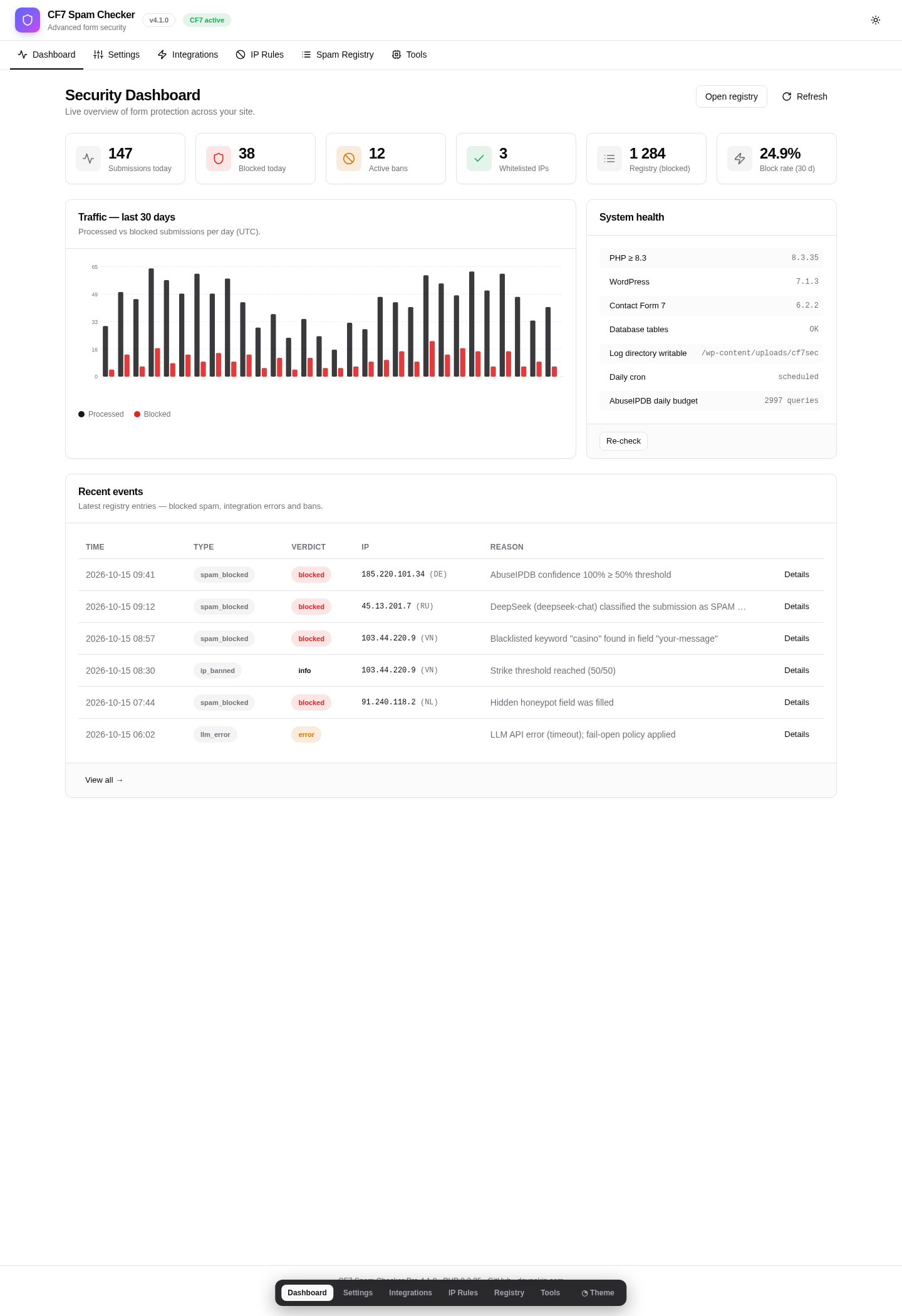
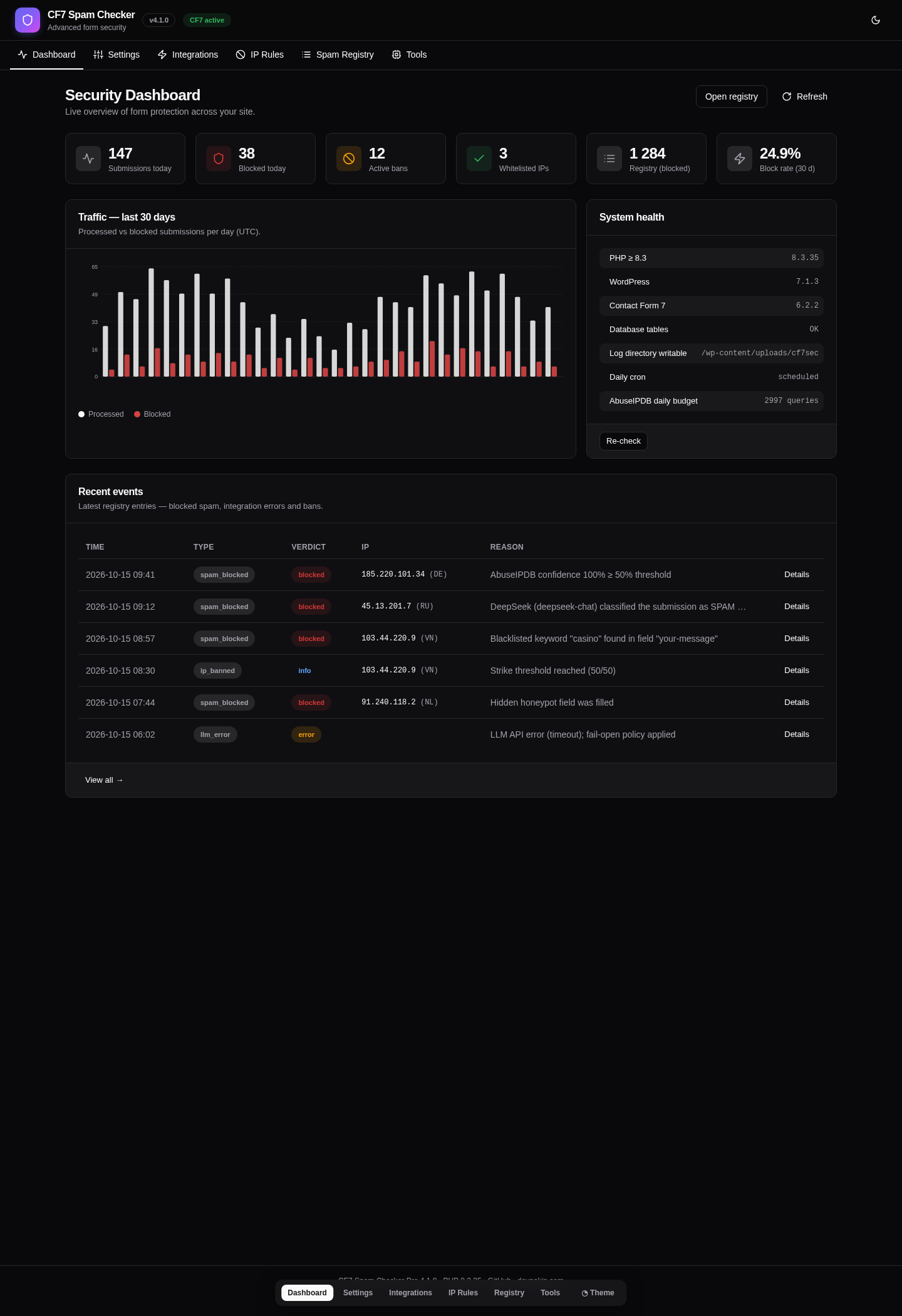
Screenshots#
| Light theme | Dark theme |
|---|---|
 |
 |
 |
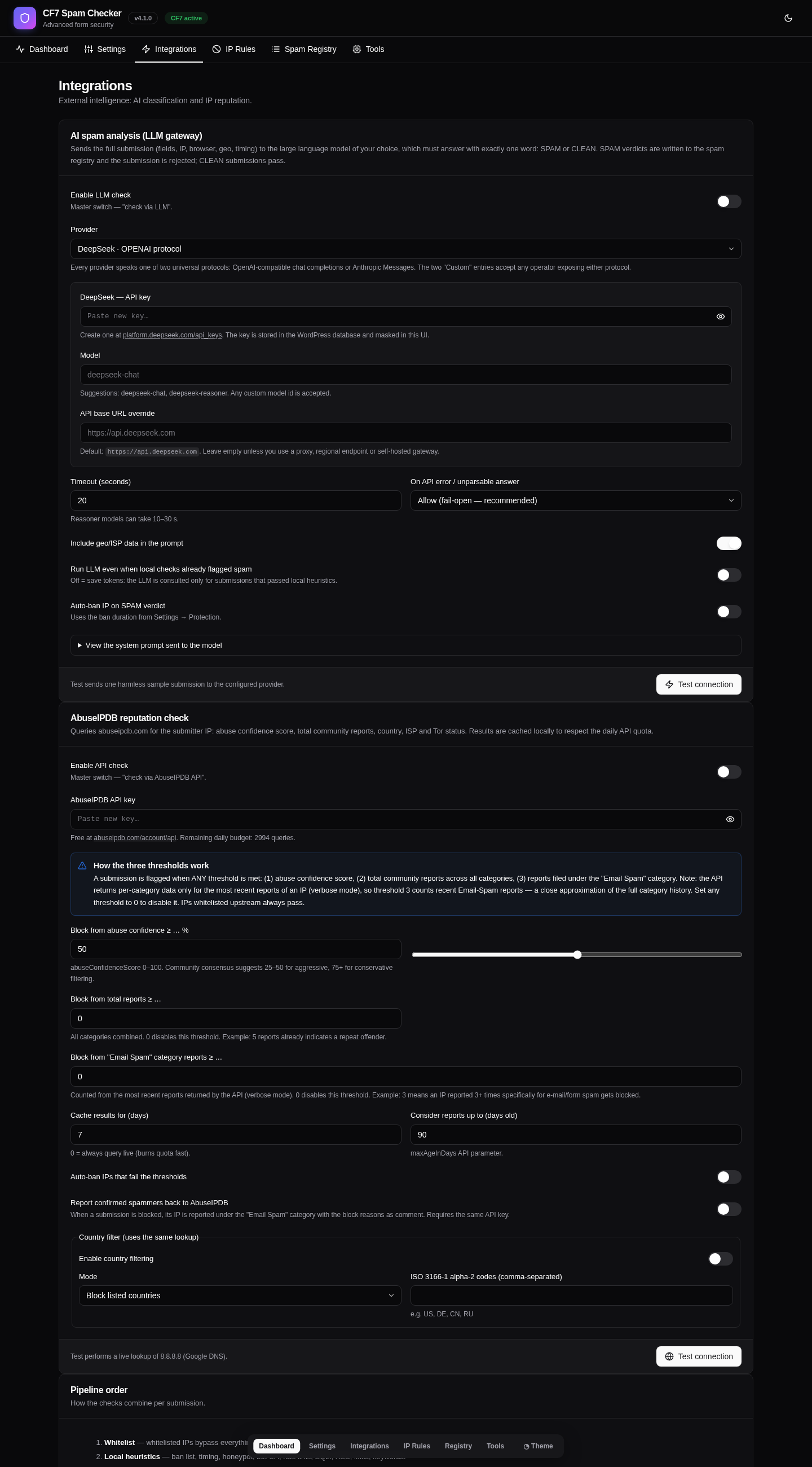 |
Interactive standalone preview of every admin page (light/dark): open docs/preview/admin-ui-preview.html in a browser (self-contained, no server needed), or use the built-in theme toggle right in wp-admin after install.
Table of Contents#
Why#
CAPTCHAs punish your visitors. Most "anti-spam" plugins stop at a honeypot. Real form spam in 2026 comes from LLM-driven bots, rotating residential proxies and Tor exit nodes — defeating it takes layered signals: behavioural, structural, reputational and semantic.
Spam Checker Pro for Contact Form 7 runs those layers in cost-aware order: free local heuristics first, paid/cloud APIs only when the submission still looks clean. Legit users are never challenged; spammers are logged to an auditable spam registry with the exact evidence that condemned them.
Features#
Protection layers#
| # | Layer | Type | Description |
|---|---|---|---|
| 0 | Whitelist | local | Whitelisted IPs bypass everything |
| 1 | IP ban list | local | Instant rejection of banned IPs (auto/manual/reputation) |
| 2 | Timing analysis | local | Human dwell-time measured client-side (monotonic timer — immune to clock skew and page caches); server-timestamp fallback with skew tolerance |
| 3 | Honeypot | local | Per-form invisible field |
| 4 | Bot user-agent | local | 60+ automation markers, headless browsers, scanners — with false-positive suppression for real browser names |
| 5 | Rate limiting | local | 60-second window per IP (atomic counter) |
| 6 | SQL-injection | local | Context-aware signatures (UNION SELECT, tautologies, stacked queries, system catalog probes…) tuned against false positives |
| 7 | XSS | local | Script tags, event handlers, dangerous URIs — including HTML-entity and URL-decoded variants |
| 8 | Link spam | local | Configurable max links per field |
| 9 | Keyword blacklist | local | Admin-editable, multibyte, case-insensitive |
| 10 | Country filter | API | Block/allow by country via AbuseIPDB geo data |
| 11 | AbuseIPDB | API | Abuse-confidence score, total reports and per-category "Email Spam" report counting (verbose mode) |
| 12 | LLM gateway | AI | Full-submission semantic analysis → strict SPAM / CLEAN verdict via 11 providers: DeepSeek, OpenAI (ChatGPT), Qwen, Anthropic Claude, Google Gemini, Groq, Mistral, OpenRouter, xAI Grok + any custom OpenAI-compatible or Anthropic-compatible endpoint |
| — | Language validation | field | 22-language character-set validation on name fields with friendly per-field errors |
Platform#
Spam registry — searchable DB log of every verdict with full evidence (per-check results, sanitized payload, UA, referrer), CSV export, retention policy (GDPR-ready).
IP management — bans + whitelist in one table, strike escalation (N-th ban becomes permanent), manual bans refuse private/reserved ranges, bulk delete, CSV export, on-demand AbuseIPDB lookup per row.
LLM gateway — one configuration surface for eleven providers over two universal protocols (OpenAI-compatible chat completions, Anthropic Messages): per-provider API keys (masked in UI), free-text model ids with suggestions, base-URL overrides for proxies/regional endpoints, timeout, fail-open/fail-closed policy, optional auto-ban on SPAM verdict, built-in connection tester.
AbuseIPDB integration — three independent thresholds (confidence %, total reports, Email-Spam-category reports), DB-backed response cache with configurable TTL, live daily-quota tracking from API headers, optional auto-reporting of confirmed spammers back to the community (category 10 "Email Spam").
Modern admin UI — Tailwind-based design system with shadcn/ui-style tokens, full light/dark/system theme (persisted, auto-detected on first visit), responsive down to 360 px, zero CDN dependencies (everything ships locally).
i18n — English, Russian (ru_RU), Simplified Chinese (zh_CN), German (de_DE); every string translatable, visitor-facing messages customizable per check.
Notifications — throttled e-mail alerts for bans, spam waves and integration errors.
Ops tooling — settings export/import (JSON), health page, debug log viewer, one-click maintenance (cron also runs daily), clean
uninstall.php.REST-first admin — all UI actions go through a nonce-protected
cf7sec/v1REST namespace withmanage_optionscapability gates.
How it works#
flowchart TD
    A[CF7 submission] --> W{IP whitelisted?}
    W -- yes --> P1[ALLOW]
    W -- no --> L[Local checks:<br/>ban list → timing → honeypot → bot UA →<br/>rate limit → SQLi → XSS → links → keywords]
    L -- flagged --> B[BLOCK + registry + strike]
    L -- clean --> R{AbuseIPDB enabled?}
    R -- yes --> R1{country filter /<br/>confidence ≥ X% /<br/>reports ≥ N /<br/>email-spam ≥ M?}
    R1 -- hit --> B
    R1 -- ok --> K{LLM gateway enabled?}
    R -- no --> K
    K -- yes --> K1{LLM verdict}
    K1 -- SPAM --> B
    K1 -- CLEAN --> P2[ALLOW]
    K1 -- error --> F[fail-open or fail-closed<br/>per settings + registry entry]
    K -- no --> P2
    B --> S{strike threshold?}
S -- yes --> BAN[auto-ban IP<br/>escalates to permanent]Design rules:
Fail open on internal errors — a security plugin must never take down your contact form. Exceptions are caught, logged and reported in the registry.
Remote checks run last and only while the submission is still clean — saves API quota and LLM tokens (configurable).
Every verdict carries evidence — the registry stores per-check results, so false positives are diagnosable in one click.
Requirements#
WordPress 6.0 – 7.1+
PHP 8.3 – 8.5+ (strict types, readonly properties, enums)
Contact Form 7 5.7+ (tested with 6.2)
Optional: an API key for any of the 11 LLM providers, AbuseIPDB API key
The plugin degrades gracefully: without CF7 it shows a notice and waits; without API keys the local layers keep working.
Installation#
From WordPress.org (once published)#
Plugins → Add New → search "Spam Checker Pro for Contact Form 7" → Install → Activate.
Manual / GitHub release#
Download
spam-checker-for-contact-form-7.zipfrom Releases.Plugins → Add New → Upload Plugin → choose the ZIP → Activate.
Activation creates four tables ({prefix}cf7sec_events, …_ip_rules, …_geo, …_daily), schedules a daily maintenance cron and — if you used v3.x — migrates your legacy settings and ban_list.json automatically.
Quick start#
Go to CF7 Security → Settings → Protection and review the layers (sane defaults are already on).
Open Integrations and add your LLM provider and/or AbuseIPDB keys; press Test connection for each.
Submit your contact form once — check Spam Registry and the Dashboard chart.
Set the visitor-facing texts under Settings → Messages if you want something friendlier than the CF7 default.
No form tags or template changes are required — protection is injected automatically via hidden fields and the wpcf7_spam pipeline.
LLM gateway setup (DeepSeek, ChatGPT, Qwen, Claude, Gemini, …)#
Pick a provider on Integrations → AI spam analysis and create a key:
Provider Protocol Key DeepSeek OpenAI platform.deepseek.com OpenAI (ChatGPT) OpenAI platform.openai.com Qwen (DashScope) OpenAI alibabacloud.com Anthropic (Claude) Anthropic console.anthropic.com Google Gemini OpenAI aistudio.google.com Groq / Mistral / OpenRouter / xAI OpenAI provider console Custom (any operator) OpenAI or Anthropic your gateway Paste the key (stored in the WP database, masked in the UI), choose or type a model id, optionally override the base URL (proxies, self-hosted vLLM/Ollama, regional endpoints), and switch on Enable LLM check.
Press Test connection — the plugin sends one harmless sample submission and shows the provider's verdict and latency.
What gets sent: a structured digest of the submission — all field values, client IP, country/ISP (when AbuseIPDB data is available), user-agent, referrer, human dwell time and the results of the local heuristics. The system prompt (viewable in the UI) forces a one-word answer: SPAM or CLEAN.
SPAM→ submission rejected, written to the registry (optionally bans the IP).CLEAN→ submission passes.API/parse error → your choice of fail-open (default — allow, log error) or fail-closed (block).
AbuseIPDB setup#
Get a free key at abuseipdb.com/account/api.
Integrations → AbuseIPDB reputation check: paste the key, switch on Enable API check.
Configure thresholds — a submission is blocked when any is met:
Abuse confidence ≥ X % (community consensus: 25–50 aggressive, 75+ conservative; default 50);
Total reports ≥ N (all categories; 0 = disabled);
"Email Spam" category reports ≥ M (0 = disabled).
Optional: auto-ban offenders, report confirmed spammers back (category 10, with block reasons as comment), country block/allow-list.
Test connection performs a live lookup of 8.8.8.8.
About per-category counts: the public Check API does not expose lifetime per-category counters, but in verbose mode it returns the most recent individual reports with their categories — the plugin counts "Email Spam" (category 10) entries among them. This is a close approximation and documented as such in the UI.
Quota safety: responses are cached in a DB table for a configurable TTL (default 7 days), the plugin tracks the remaining daily budget from the API's own x-ratelimit-remaining header, and remote checks run only for submissions that passed local heuristics.
Privacy#
Nothing leaves your site until you opt in. Both integrations ship disabled; without an API key no data is ever transmitted, and neither integration is enabled implicitly by installing or updating the plugin.
| Where | What leaves your site | When |
|---|---|---|
| Your own database | Blocked submissions (verdict, IP, country, reasons, per-check evidence, payload) | Always, kept for the configured retention period |
wp-content/uploads/cf7sec/ |
Debug log lines | Only if you switch debug logging on |
abuseipdb.com |
The submitter's IP address, to read its abuse-confidence score and report counts. If community reporting is enabled, the IP of a confirmed spammer is submitted back | Only if the AbuseIPDB integration is enabled with an API key |
| One LLM provider of your choice | The submission digest: every form field value, the submitter IP, country/ISP when available, user agent, referrer, human dwell time and the local check results | Only if the LLM gateway is enabled with an API key |
The provider that receives the digest is exactly the one you select — DeepSeek, OpenAI (ChatGPT), Qwen (Alibaba DashScope, dashscope.aliyuncs.com / dashscope-intl.aliyuncs.com), Anthropic Claude (api.anthropic.com), Google Gemini (generativelanguage.googleapis.com), Groq (api.groq.com), Mistral AI (api.mistral.ai), OpenRouter (openrouter.ai), xAI Grok (api.x.ai), or a custom OpenAI-compatible / Anthropic-compatible endpoint whose base URL you supply yourself.
Uninstalling removes all plugin data unless Keep data on uninstall is enabled. See readme.txt for the same disclosure in the directory listing format.
Admin dashboard#
| Page | What you do there |
|---|---|
| Dashboard | Today/30-day KPIs, processed-vs-blocked chart, system health, recent events |
| Settings | General (scope, retention, IP detection), Protection (all 10 local layers + parameters), Messages, Notifications, Diagnostics (debug log viewer) |
| Integrations | LLM gateway + AbuseIPDB configuration & self-tests, pipeline order card |
| IP Rules | Ban list & whitelist: add/search/delete/bulk-delete, strikes, expiry, CSV export, per-IP AbuseIPDB lookup |
| Spam Registry | Filter by verdict/type/date/text, evidence modal per event (checks, payload, UA), CSV export, purge |
| Tools | Settings export/import, manual maintenance, geo-cache clear, stats reset, IP lookup, requirements check, danger zone |
Theme toggle (top bar) cycles light → dark → system; the choice persists in localStorage and is auto-detected from your OS on first visit.
Developer reference#
Filters & actions#
/**
 * Fires after an IP has been banned.
 * @param string $ip
 * @param string $reason
 * @param bool   $permanent
 */
do_action( 'cf7sec_ip_banned', $ip, $reason, $permanent );

/** Fires after the daily maintenance run. */
do_action( 'cf7sec_after_cleanup' );
The pipeline consumes the standard CF7 filters: wpcf7_spam (priority 5), wpcf7_validate_{text,email,tel,textarea} (language validation), wpcf7_form_hidden_fields, wpcf7_display_message (custom spam messages), wpcf7_editor_panels.
REST API (cf7sec/v1)#
All routes require manage_options + X-WP-Nonce:
GET|POST /settings          read (masked secrets) / save
POST     /settings/reset    factory defaults
GET      /stats?days=30     chart series + totals
GET      /health            environment diagnostics
GET      /events            registry list (filters: verdict, event_type, search, from, to, page)
GET      /events/{id}       event with full evidence
GET      /events/export     CSV
POST     /events/clear      truncate registry
GET|POST /ip-rules          list / add (ban|whitelist)
DELETE   /ip-rules/{ip}     remove
POST     /ip-rules/bulk-delete
POST     /ip-lookup         on-demand AbuseIPDB lookup
POST     /test/deepseek | /test/abuseipdb | /test/email
GET      /export · POST /import    settings backup
POST     /cleanup           run maintenance now
GET      /logs · /logs/dates · DELETE /logs    debug log viewer
Adding a custom check#
use CF7Sec\Security\{CheckInterface, CheckResult, SubmissionContext};

final class MyCheck implements CheckInterface {
    public function id(): string { return 'my_check'; }
    public function label(): string { return 'My check'; }
    public function enabled(SubmissionContext $c): bool { return true; }
    public function run(SubmissionContext $c): CheckResult {
        return $c->postedData['email'] === 'spam@spam.test'
            ? CheckResult::fail('my_check', 'Known spam address', 'keyword_spam')
            : CheckResult::pass('my_check');
    }
}
Compose it into a pipeline by subclassing, or simply block via the standard wpcf7_spam filter for lightweight cases.
Architecture#
spam-checker-for-contact-form-7/
├── spam-checker-for-contact-form-7.php   # bootstrap: constants, PSR-4 autoloader, guards
├── uninstall.php                     # full data purge (unless keep_data)
├── src/                              # namespace CF7Sec\ (PHP 8.3+, strict types)
│   ├── Plugin.php                    # composition root, hook wiring
│   ├── Settings.php                  # schema, defaults, sanitisation, secret masking
│   ├── Activator.php / Deactivator.php / Cron.php
│   ├── Languages.php                 # 22-language regex registry
│   ├── Security/                     # SpamPipeline + CheckResult/Status/Context
│   │   ├── Checks/                   # 11 checks, one class per file
│   │   ├── Patterns.php              # SQLi/XSS/bot-UA signature registries
│   │   ├── LlmPrompt.php             # submission digest builder
│   │   └── LanguageValidator.php     # wpcf7_validate_* integration
│   ├── Services/                     # Llm gateway, AbuseIpDb, BanManager, Mailer, Logger
│   ├── Storage/                      # EventsRepository, IpRuleRepository, GeoCache, DailyStats
│   ├── Support/                      # Ip (proxy-aware resolution), mbstring compat
│   └── Admin/                        # AdminMenu, Assets, PageRenderer, RestController,
│       └── Views/pages/              # dashboard, settings, integrations, ip-rules, registry, tools
├── assets/
│   ├── src/                          # input.css (design system) + admin.js (SPA-ish UI)
│   └── dist/                         # built assets — committed, no build step needed in prod
├── languages/                        # .pot + ru_RU/zh_CN/de_DE (.po + .mo)
├── tests/                            # smoke.php (no WP) + wp-integration.php (real WP+CF7)
└── tools/                            # POT extraction + i18n/MO compiler (pure Python)
Storage: 4 custom tables — cf7sec_events (registry), cf7sec_ip_rules (ban/whitelist/strikes), cf7sec_geo (AbuseIPDB cache), cf7sec_daily (aggregate counters). No more JSON files in wp-content/ (v3 legacy data is migrated on activation — and on a regular plugin update).
Full details: docs/ARCHITECTURE.md.
Upgrading from v3.x#
Install v4 over the old plugin (same folder name) and activate.
On activation the plugin automatically:
migrates
cf7sec_options(feature flags, rate limits, ban duration, custom messages) into the new schema;imports
wp-content/cf7sec_logs/ban_list.jsoninto the newip_rulestable (expired bans dropped) and renames it*.migrated;keeps the old JSON files in place for reference (delete manually once satisfied).
Re-check Settings → Protection — v4 adds parameters that did not exist in v3.
Behavioural notes: hidden field names changed (cf7sec_ts, cf7sec_age, cf7sec_hp_*); the client-side timer is new and strictly better with page caching. The legacy _cf7a_timestamp check never actually received data under CF7 ≥ 5.9 (CF7 strips _-prefixed POST keys from posted_data) — v4 fixes this class of silent failures.
Development#
# assets (only needed when changing CSS/JS sources; assets/dist is committed)
npm install tailwindcss@3 --no-save
mkdir -p assets/dist
npm run build

# tests (all of them, in order)
npm test
# or individually:
php tests/smoke.php                        # pure logic, no WordPress needed
php tests/settings-paths.php               # guard: no dead settings paths (B1)
php tests/assets-built.php                 # guard: dist assets + class coverage (B3/M1)
php tests/upgrade-4.0-to-4.1.php           # guard: upgrade preserves LLM config (B2)
php tests/docs-links.php                   # guard: documentation links resolve
wp eval-file tests/wp-integration.php \
   --path=/path/to/wp                      # full stack: real WP + CF7 + MySQL
                                           # set CF7SEC_TEST_ABUSE_KEY for live API tests

# i18n (cross-platform: node tools/py.js picks python3 or python)
npm run i18n:extract                       # regenerate languages/*.pot
npm run i18n:build                         # rebuild .po/.mo from tools/i18n-*.py
Code style: PSR-12-ish, declare(strict_types=1) everywhere, PHPDoc on public APIs, no global state outside the composition root.
License#
GPL-2.0-or-later — see LICENSE.txt.
Developed by Mikhail Deynekin — deynekin.com · 2026